Typical applications for grounding rings for MAG flowmeters
Grounding rings for MAG flowmeters are used in various applications to ensure accurate and reliable flow measurement. Here are some typical applications:
Flow meter grounding or earth rings ground the process, reducing noise and removing stray energy that can affect the gauge’s accuracy from the process flow.
Gronding rings applications
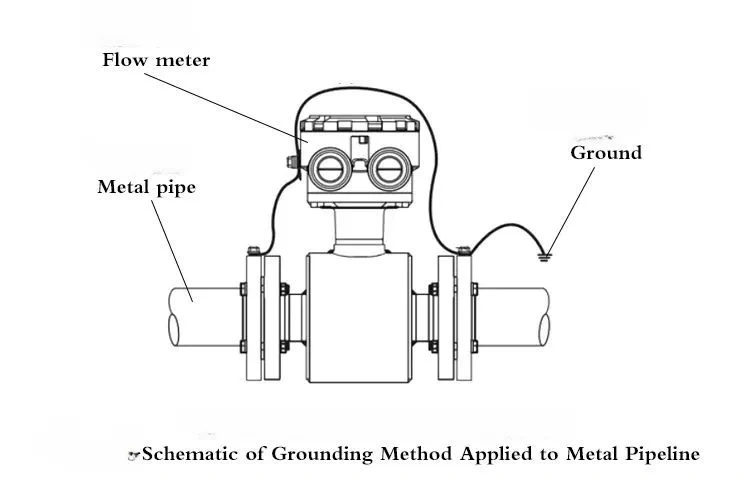
Flanged-style magmeter flowtube installed in metal process pipe.
For any magnetic flowmeter to function correctly, it must have three connections (including a ground) to the process liquid passed from the magnetic flow tube onto the magnetic flow transmitter. About 80 per cent of the time, problems with the flow measurement readings provided by a magnetic flowmeter can be traced directly to improper solution ground connections.
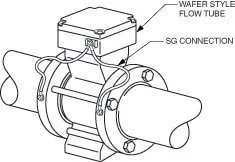
Typical wafer-style magmeter flowtube with supplied SG wires installed in flanged metal process pipe.
A grounding electrode is a metal rod or plate that is driven into the ground to provide a low-impedance path to earth. The electrode is connected to the flow meter to provide a direct ground connection. Grounding electrodes are commonly used in applications where the process fluid is non-conductive, such as in oil and gas production, food and beverage processing, and pharmaceutical manufacturing.
Flanged-style magmeter flowtube with SG grounding straps and rings installed in nonmetallic pipe.
Grounding electrodes are effective at providing a stable ground connection in non-conductive environments. However, they may be less effective at reducing the effects of EMI and RFI on the flow meter.
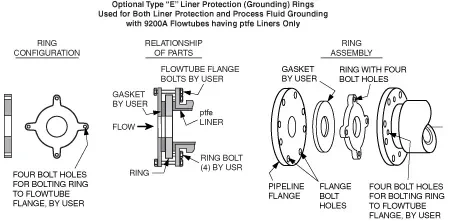
Magnetic Flowmeter liner protection (grounding) rings used for both liner protection and process fluid grounding with PTFE.
Magnetic flowmeter systems are often preferred for hazardous process liquid applications due to their availability in numerous liner and electrode material choices. This provides compatibility with many hazardous chemicals, making them a safer option.
If grounding rings or electrodes are required, they should be made from the same material as the measuring electrode to ensure chemical compatibility with the process liquid. This is crucial to avoid potential damage to the electrode and the system as a whole.
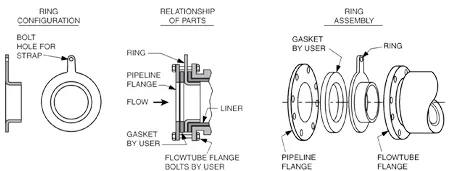
Magmeter liner protection (grounding) rings with Neoprene, EPDM, Linatex, or Ebonite.
In such applications, the adjacent process piping is usually nonmetallic or lined. Grounding electrodes can offer substantial cost savings over grounding rings made from exotic materials, as the latter are more expensive. Additionally, grounding electrodes are easier to install and have fewer leak points, further increasing their cost-effectiveness.
In conclusion, the availability of numerous liner and electrode material choices makes magnetic flowmeter systems a safer option for hazardous process liquid applications. When grounding rings or electrodes are required, they should be made from the same material as the measuring electrode, and grounding electrodes can be a cost-effective alternative to grounding rings.
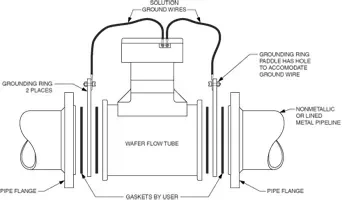
Magmeter wafer-style flowtube installed in non-metallic pipe
Proper installation of flow tubes is essential for accurate SG connection in magnetic flow meters. In the case of metal process piping, correctly installed flow tubes eliminate the need for additional solution grounding rings or electrodes. However, nonmetallic pipe or liner configurations require a solution ground method, and great care must be taken with grounding ring or electrode connections and placement. Below are some tips for achieving proper SG connections to the magnetic flow transmitter.
SG Connection with Metal Process Pipe Flanged-style flow tubes: The most common way to pass the SG connection from the process onto the magnetic flow tube’s body/case is by using flanged, unlined, metal process pipe bolted to a flanged magnetic flow tube (Figure 1). When the metal flanges on each side of the magnetic flow tube are bolted to the magnetic flow tube’s metal flanges, the SG connection is made, and it passes onto the magnetic flow tube’s body/case, eventually reaching the magnetic flow transmitter. Grounding rings or electrodes are not required in this metal-to-metal installation scenario.
Do you need more info about the grouding rings?
Find answers to common questions about grounding rings.
UNDER CONSTRUCTION.
UNDER CONSTRUCTION.
UNDER CONSTRUCTION.

Let's talk about your next project
Click the button to fill out a form or give us a call.